The curious case of communities in collections of connections
David Gleich
Purdue University
David Gleich · UIUC1
1. What is a community?
2. How do we detect a community?
use a score + optimization
3. Global community detection has a problem
4. Local community detection side-steps it
5. There are good algorithms for local community detection
neighborhoods, PageRank / spectral, flow-based methods
6. We can combine these ideas.
7. There aren’t just “one” set of communities in most empirical networks.
8. You can use a model to change the data you were given!
David Gleich · UIUC2
What is a community?
David Gleich · UIUC3
What is a community?
David Gleich · UIUC4
An algorithm.
A score.
An algorithm for optimizing a score.
“Physics”
(behavior of some process)
“Statistics and Probability”
(which often give either an algorithm or a score)
How do we detect a community?
David Gleich · UIUC5
An algorithm.
A score.
An algorithm for optimizing a score.
“Physics”
(behavior of some process)
“Statistics and Probability”
(which often give either an algorithm or a score)
How do we detect a community?
David Gleich · UIUC6
An algorithm.
A score.
An algorithm for optimizing a score.
“Physics”
(behavior of some process)
“Statistics and Probability”
(which often give either an algorithm or a score)
How do we detect a community?
David Gleich · UIUC7
How do we detect a community?
David Gleich · UIUC8
min score(communities) s.t. we have a partition into communities
or
max score(communities) s.t. we have a partition into communities
Given any score function, there is a simple objective function
David Gleich · UIUC9
This setup has a problem and allows action at a distance
David Gleich · UIUC10
Local clustering is a way around this.
Global clustering
find all the communities
Local clustering
find the community for a single node
David Gleich · UIUC11
Local clustering is a way around this.
volume(S) is the sum of degrees for all nodes in S
volume*(S) is the sum of degrees for all nodes in S
unless S is more than half the total edges, when it flips
Depends on the entire graph!
Only depends on S
David Gleich · UIUC12
We will focus on conductance clustering
This can be generalized to weighted cuts and positive “per-node” volume weights.
(same caveat on the sum needs to be less than half the total)
There are good algorithms for local clustering: neighborhoods, ACL, Flow
David Gleich · UIUC13
Gleich & Seshadhri 2011
If a graph has a power-law degree distribution and high clustering coefficients, then there are vertex neighborhoods that are non-trivial conductance sets.
- Algorithm: Check conductance of all vertex neighborhoods (purely local!)
Andersen Chung & Lang 2006 (and many followups)
For a graph and a node , then we can find a set with nearby with conductance related to the best set containing .
Lang & Rao 2004 (and many followups)
For a graph and a set less than half volume, we can find the minimal conductance set contained within .
There are good algorithms for local conductance: neighborhoods, ACL, Flow
… paraphrased theorems …
David Gleich · UIUC14
There are good algorithms for local conductance: neighborhoods, ACL, Flow
Algorithm. Find all 1-hop neighborhoods. Compute their conductance.
This can be done with something like a triangle counting algorithm.
Find locally minimally groups,
conductance(neighborhood()) conductance(neighborhood()) where
David Gleich · UIUC15
The Andersen-Chung-Lang algorithm approximates a PageRank vector with a nice sparse algorithm.
There are good algorithms for local conductance: neighborhoods, ACL, Flow
David Gleich · UIUC16
David Gleich · UIUC17
the MQI method gives an
exact local clustering algorithm
Given and with volume() volume()/2, then find a set with
minimum condutance() s.t.
David Gleich · UIUC18
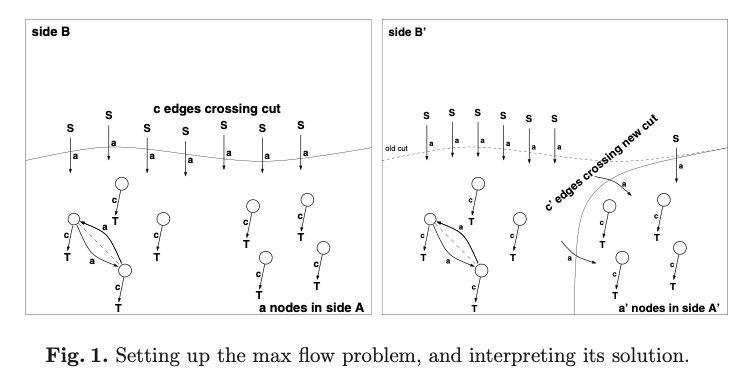
the MQI method gives an
exact local clustering algorithm
Given and with volume() volume()/2, then find a set with
minimum condutance() s.t.
David Gleich · UIUC19
if and if conductance() then
cut() volume() or
cut() - volume() 0
0 cut() - volume() + volume() volume()
0 cut() + volume() volume()
if we find a set where cut() + volume() volume()
then the minimum is less than
the MQI method gives an
exact local clustering algorithm
David Gleich · UIUC20
How MQI works.
David Gleich · UIUC21
David Gleich · UIUC22
Convergence
Theorem A. You always improve by at least one edge. So O(volume()*maxflow) time in the worst cast.
Theorem B. You can do binary search on in O(log(volume()) time.
… BUT …
We never see the worst case for Theorem A. Solving this is still an open problem.
the MQI method gives an
exact local clustering algorithm
David Gleich · UIUC23
FlowImprove. Andersen & Lang 2008 / LocalFlowImprove. Orecchia & Zhu 2014
minimize cut() / rvol(; , ) s.t rvol > 0
rvol() = volume() - volume()
If volume(R), then equivalent to MQI
If volume() / volume() then it's called FlowImprove
Theorem (Fountalakis, Meng, Gleich, Mahoney, 2023)
Fix . conductance(MQI()) conductance(LFI()) conductance(FI())
MQI clusters cannot grow. But LocalFlowImprove Clusters Can!
David Gleich · UIUC24
PageRank
Flow
there is a neat relationship between these flow problems and ACL-like PageRank problems by looking at flow as 1-norm and spectral / PageRank as 2-norm
minimize cut() - volume() s.t. …
minimize s.t …
minimize s.t. ...
Flow vs. spectral is just
1-norm vs. 2-norm
David Gleich · UIUC25
David Gleich · UIUC26
David Gleich · UIUC27
We can combine these ideas.
Let ACL grow, use MQI to refine.
David Gleich · UIUC28
David Gleich · UIUC29
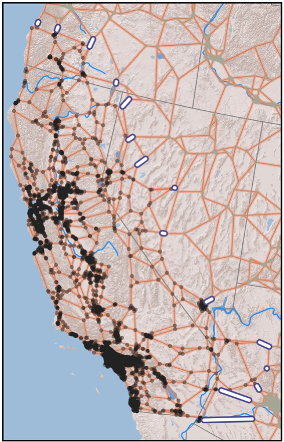
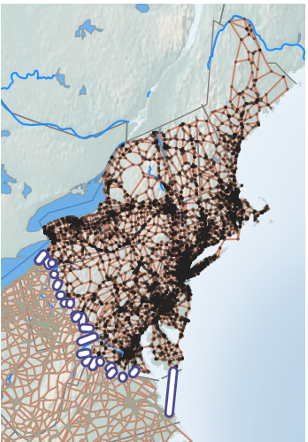
Road networks make great examples!
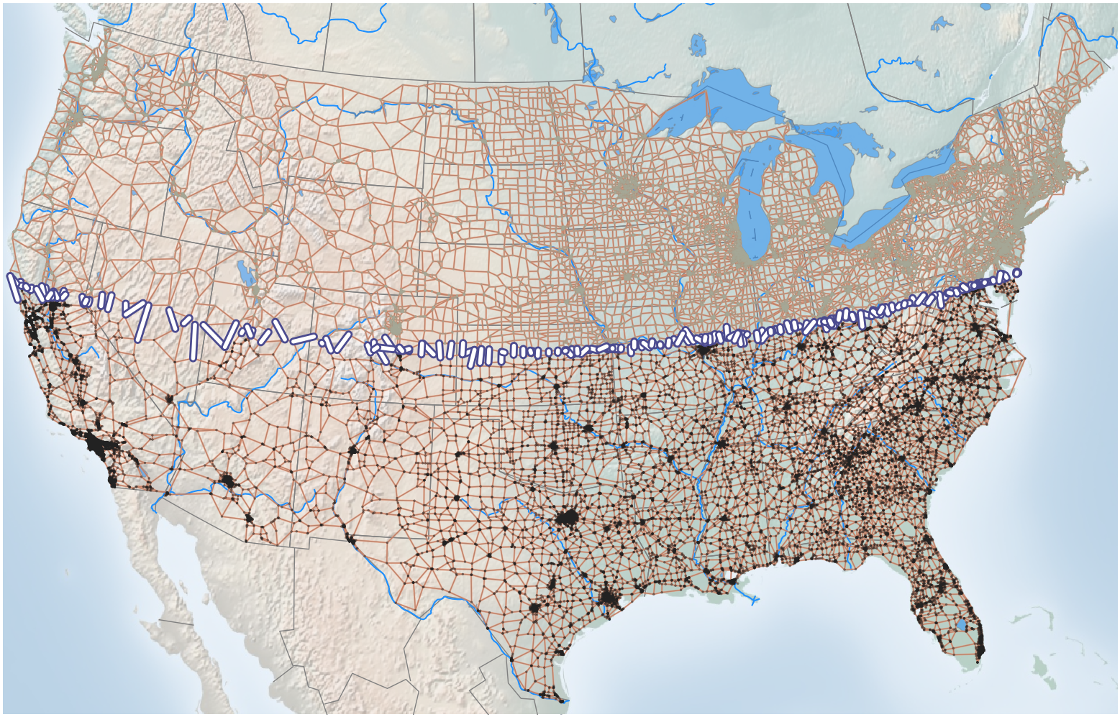
The south is the reference set
David Gleich · UIUC30
Road networks make great examples!
The south is the reference set
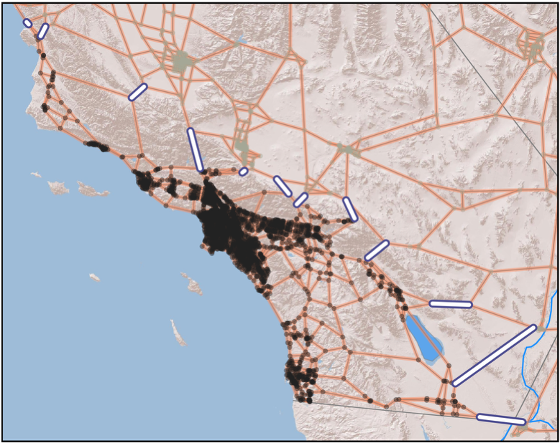
LocalFlowImprove
finds California
David Gleich · UIUC31
Road networks make great examples!
The south is the reference set
LocalFlowImprove
finds California
David Gleich · UIUC32
Road networks make great examples!
The south is the reference set
FlowImprove
finds the northeast
David Gleich · UIUC33
… back to the entire graph …
David Gleich · UIUC34
Network community profiles show the results of many local clusters
Network Community Profile plots show conductance and size tradeoffs for many different communities.
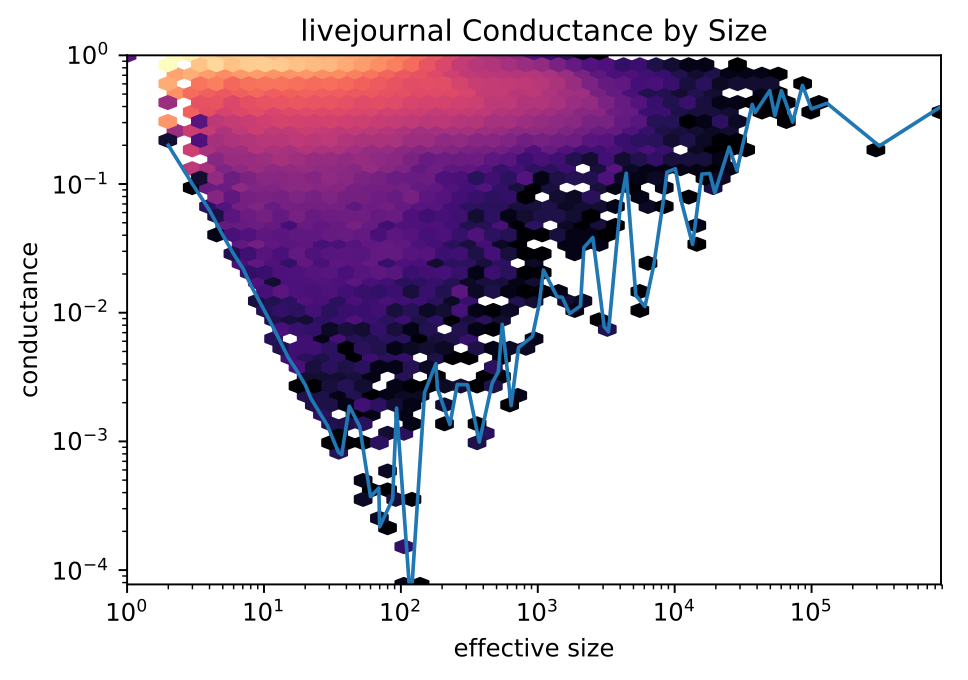
Leskovec, Lang, Dasgupta, Mahoney, 2007-2009
David Gleich · UIUC35
We can combine these ideas.
Let ACL grow, use MQI to refine.
Network Community Profile plots show conductance and size tradeoffs for many different communities.
Leskovec, Lang, Dasgupta, Mahoney, 2007-2009
We initially get better and better clusters as they get bigger
David Gleich · UIUC36
We can combine these ideas.
Let ACL grow, use MQI to refine.
Network Community Profile plots show conductance and size tradeoffs for many different communities.
We initially get better and better clusters as they get bigger
Clusters get worse as they get bigger
Leskovec, Lang, Dasgupta, Mahoney, 2007-2009
David Gleich · UIUC37
We can combine these ideas.
Let ACL grow, use MQI to refine.
Network Community Profile plots show conductance and size tradeoffs for many different communities.
We initially get better and better clusters as they get bigger
Clusters get worse as they get bigger
At some point the volume denominator kicks in and they get slightly better
Leskovec, Lang, Dasgupta, Mahoney, 2007-2009
David Gleich · UIUC38
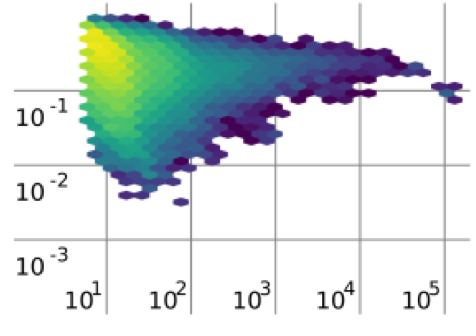
The finding and structure are reliable
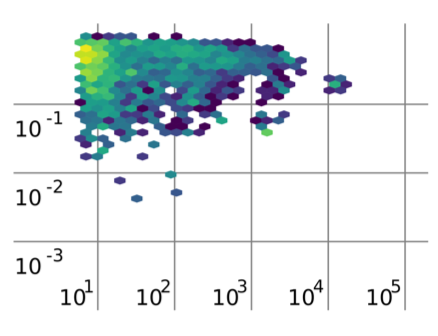
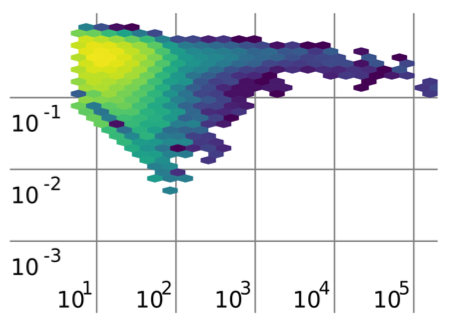
Cond.
Size
Collaboration Network
Email Network
Facebook Interactions
~50 or 80 networks in the original paper
broadly holds for different clustering metrics too
something slightly different for very dense (avg deg >= 150) empirical networks
discussions of origins by Schoenebeck (2013) and Rohe (2018)
David Gleich · UIUC39
Networks in physics / CSE often have very good large conductance clusters
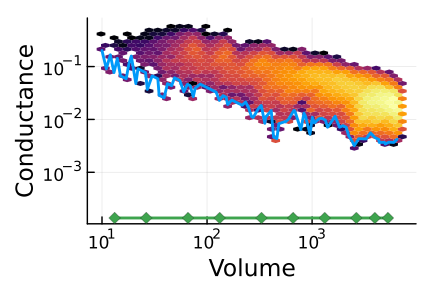
US Power Grid
Many good conductance clusters that are large
David Gleich · UIUC40
… one last point …
David Gleich · UIUC41
your data are not your model!
Remember to think about your problem
Benson, Gleich, Leskovec 2016.
Use Motifs to handle more general graph data.
David Gleich · UIUC42
your data are not your model!
Remember to think about your problem
Epasto, Lattanzi, & Paudice 2017. Partition neighbors of egonet. and build a new graph.
David Gleich · UIUC43
1. If there are really obvious communities, it tends not to matter what you do.
2. If there aren’t, it greatly matters!
3. Generally, there aren’t great communities.
Better than random? Yes. But where the details don’t matter? No.
4. Remember that the data you are given is not the model you need to use.
Building new models from this data is often useful!
5. Look at distributions / overlaps / etc. – a node is in many “communities”
Some lessions
David Gleich · UIUC44